
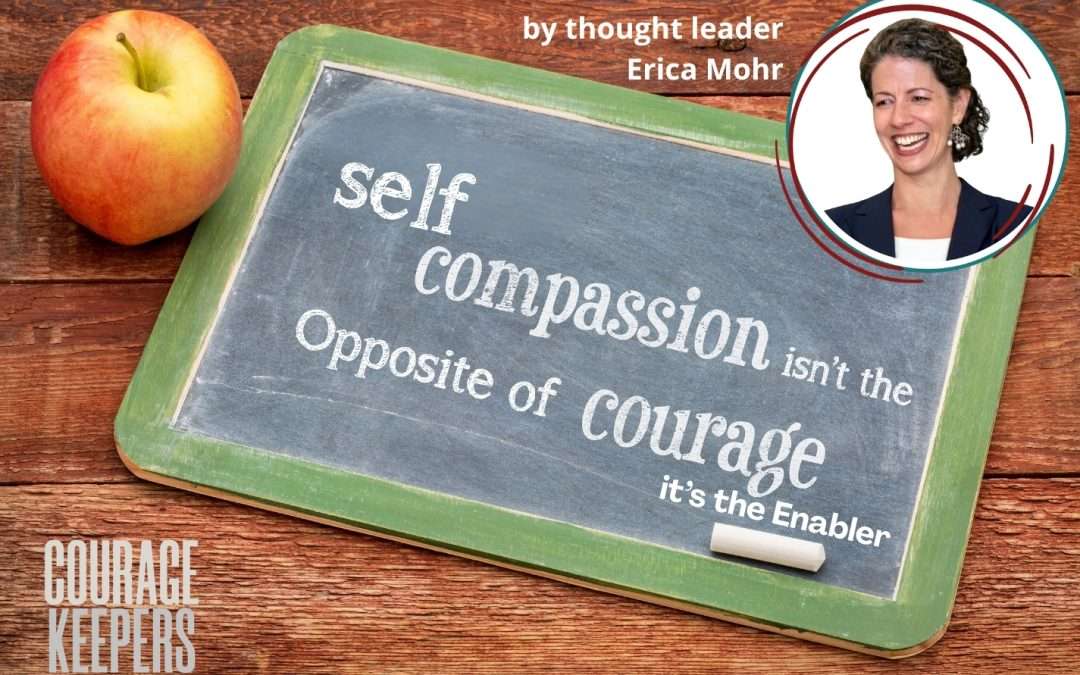
As a coach, I’m trained to listen for binary thinking; choices that are framed as either or. One binary belief that gets in people’s way is the myth that you must choose between courage or self-compassion. From the work of Kristin Neff, self-compassion doesn’t mean lowering our standards. It means we choose to face our own suffering with love rather than judgment. And from a place of love, courage is even more possible.
Scenario 1: Pria was just promoted to VP and was about to lead her first team off site. Without self-compassion, the voice in her head was brutal, “You’re terrified. You feel this way because you are weak and not ready to be a VP. They are going to laugh you out of the room.” Thankfully, Pria turned up the voice of self-compassion instead, “Of course, you feel terrified. Promotions are intimidating. What do you need to support yourself as I take this big leap?” And as a result, Pria showed up authentic and grounded and ready to listen and learn from her new colleagues.
Scenario 2: As department head, Lu’s very public product launch failure left him devastated and fearing for his job. Without self-compassion, Lu pushed down the hurt and didn’t see how admitting his feelings would help anyone. As he grew his self-compassion muscle, the voice in his head shifted to, “Oph. That was hard. That pain you’re feeling is evidence of how much you really wanted this to work out and how much you believed in this product. What did you learn from this failure that will ultimately help you grow?” As he faced this moment with self-compassion, rather than denying his experience, he was surprised to notice the positive impact on his wellbeing. His anxiety eased, he started sleeping through the night again, and could see a future—even at another firm—where he would be willing to take another risk.
Self-compassion isn’t an excuse not to be brave; it is a way to be with our own humanity so that we create our own safety to be courageous again and again.